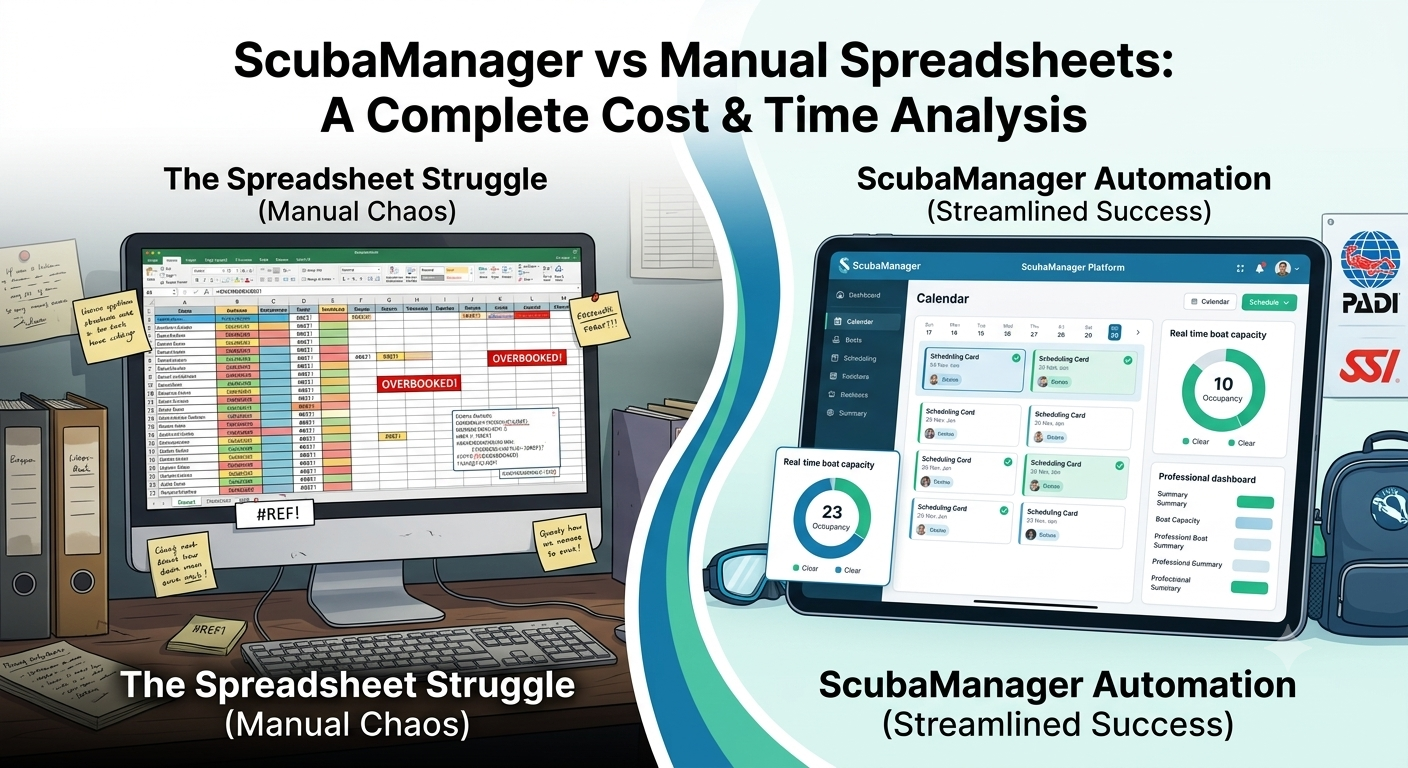
How to Manage a Dive Center in 2026: The Complete Operations Guide
Running a dive center is unlike managing any other business on earth. On any given day, you are a maritime logistics coordinator, an educational dean supervising safety standards, a retail store manager, a hospitality director, and a high-pressure equipment technician. You are responsible not just for your profit margins, but for the physical safety of people breathing underwater under your team's direct supervision.
The global dive tourism and training landscape has evolved dramatically. Modern divers are looking for digital efficiency, hyper-personalized experiences, and rigorous safety standards. The old methods of hanging a chalkboard by the shop door and hoping for walk-ins simply will not sustain a profitable operation anymore.
Whether you are an ambitious Course Director looking to launch your first shop, or a seasoned business owner modernizing an existing facility, this ultimate guide provides a comprehensive framework for mastering dive center operations in the current market.
1. Foundational Management: Daily, Weekly, and Monthly Pillars
To build a profitable dive shop workflow, you must separate your operations into structural cadences. Without standardized checklists, critical details like cylinder testing or instructor insurance renewals get missed in the morning rush.
1.1 Daily Operational Baselines
A flawless day on the boat starts the night before, but the morning check-in sets the tone. Your daily front-of-house and back-of-house routines should be structured as unyielding frameworks:
- The Morning Roster Verification (07:00 – 08:00): Before any engines start or compressors run, a manager must cross-verify that every customer manifest aligns with physical liability waivers, medical clearings, and verified certification limits.
- The Logistical Hand-off (08:00 – 08:30): Boat captains and instructional leads must run brief, structured huddles. The shop team must pass critical customer data — such as dietary restrictions, equipment rental sizing, and nitrox preferences — directly to the maritime crew.
- The End-of-Day Reconciliation (17:00 – 18:00): Close the loop by reconciling retail point-of-sale systems, tracking air/nitrox compressor hours against cylinder fills, and logging any equipment malfunctions reported during the day.
1.2 Weekly and Monthly Cadences
Move away from firefighting daily emergencies by introducing macro operational reviews:
- Weekly Crew Briefing: A 30-minute Monday huddle to review the week's bookings, identify staffing gaps, and assign continuing-education slots for instructors.
- Weekly Asset Audit: Walk the rental room and boats. Visually inspect regulators, BCDs, wetsuits, and tanks for damage. Flag anything for service before it lands on a boat.
- Monthly Financial Review: Compare revenue per boat trip, cost per certification, and gross margin per retail product. Cancel underperforming trip slots and double down on high-margin courses.
- Quarterly Compliance Sweep: Review insurance policies, captain licenses, first-aid certifications, oxygen unit inspections, and emergency action plans.
1.3 Safety Compliance Frameworks
Safety is your brand's ultimate currency. A robust dive shop management guide must prioritize a zero-compromise compliance ledger. Maintain an easily accessible digital vault holding active staff liability insurance documents, emergency oxygen unit inspection dates, and local coast guard commercial vessel certifications. If an incident occurs, having a clean, time-stamped digital paper trail protects your center from devastating liability exposure.
2. Booking & Scheduling Management: Balancing Boats and Assets
The core revenue engine of your business is asset utilization: matching human instructors and physical boats to active customer demand without creating logistical bottlenecks.
2.1 Structuring Your Reservation Workflow
A modern reservation system must be automated, omni-channel, and live. If a traveler in New York wants to book a night dive in your Caribbean shop at 2:00 AM, they should be able to see exact boat availability and complete their payment instantly.
Your booking flow must enforce mandatory compliance gates before checking out. The moment a transaction occurs, the software should require digital signatures on liability waivers, medical history profiles, and training agency certification numbers. This ensures your morning desk staff spend their time welcoming guests rather than chasing down missing paperwork.
2.2 Advanced Vessel Optimization
Every turn of a boat propeller costs money in fuel, maintenance hours, and captain wages. Operating an identical vessel with 4 divers versus 12 divers can be the difference between a major financial loss and a highly profitable day.
Implement a dynamic boat allocation matrix:
Example only. The names and numbers are made up. Your break-even depends on your own costs.
| Vessel Name | Passenger Capacity | Minimum Break-Even Passengers | Primary Operational Route |
|---|---|---|---|
| Reef Explorer | 12 Divers | 4 Divers | Local shallow reefs & multi-level training |
| Deep Blue Marine | 24 Divers | 9 Divers | Offshore wrecks & technical excursions |
| Sea Scout (RIB) | 6 Divers | 2 Divers | Private charters & advanced drift diving |
If your weekly booking schedule shows fragmented groups across multiple days, consolidate trips onto a single vessel to reduce operational overhead, and reallocate free instructors to run high-margin continuing education courses ashore.
3. Client Management: From Discovery to Lifelong Community
Customer acquisition in diving is expensive. True profitability comes from your ability to transform a one-time Discover Scuba Diving (DSD) participant into an Open Water student, an Advanced diver, and a lifelong gear-purchasing client.
3.1 The Integrated Customer Database
Stop tracking your customers on individual clipboards or disparate mail systems. Your client database should maintain a unified chronological record for every diver.
With Scuba Manager, this user data is integrated dynamically. It displays certification level, logged dives and equipment sizing in one place. Having instant access to this level of detail allows your retail team to personalize every interaction. If a customer walks into the shop, your team can greet them by name, instantly pull their correct gear sizes from the locker, and confidently recommend an upcoming Rescue or Specialty course that perfectly fits their training path.
3.2 Customer Retention Strategies
The dive journey shouldn't stop when the boat docks. Implement automated post-dive re-engagement pathways. Twenty-four hours after a customer finishes a course or charter, send an automated follow-up thanking them for diving with you, delivering digital links to underwater photos taken by your crew, and offering a targeted incentive toward their next certification tier.
Build a local community by organizing monthly beach cleanups, hosting pool nights for equipment testing, and managing travel clubs to international dive destinations during your local low season.
4. Equipment & Asset Management: Protecting Your Infrastructure
Your compressor, cylinders, and rental gear are the lifeblood of your center. Neglecting these physical assets compromises customer safety and drains your cash flow through sudden equipment failures.
4.1 Cylinder Fleet Maintenance
Managing a fleet of 100+ scuba cylinders requires absolute precision. Every cylinder requires an annual visual inspection (VIP) and a recurring hydrostatic test, on the schedule set by local regulations and the cylinder maker. Missing a single test date can mean a tank is illegal to fill — and worse, unsafe for the diver breathing from it.
Maintain a digital asset register with each cylinder's serial number, VIP date, hydro date, and current service status. Tag any tank approaching expiry 30 days in advance and pull it from rotation until it is re-certified.
4.2 Rental Gear Lifecycle
BCDs, regulators, and wetsuits all have predictable service intervals. Build a rotation system that retires gear at a fixed number of dives or calendar months, whichever comes first. Customers notice the difference between a frayed 8-year-old wetsuit and a clean, well-maintained one — and that perception drives repeat bookings.
4.3 Boat and Compressor Care
Log engine hours, oil changes, and compressor filter swaps in the same operational system as your bookings. When maintenance is invisible, it gets skipped. When it sits next to tomorrow's trip roster, it gets done.
5. Staff & Instructor Management
Your team is the product. A perfectly maintained boat with a disengaged divemaster will lose customers faster than an old boat with a brilliant crew.
5.1 Hiring and Onboarding
Hire for attitude and customer skills first; certifications second. Technical skills can be taught. Patience with a nervous Discover Scuba student cannot.
Build a structured onboarding checklist covering local site briefings, emergency action plans, customer service standards, and your software workflows. New instructors should be productive within their first week, not their first month.
5.2 Scheduling and Workload Balance
Rotate instructors across morning and afternoon trips to prevent burnout. Track teaching hours, in-water time, and days off in a single source of truth so no one quietly works 20 days straight in high season.
5.3 Continuing Education
Sponsor at least one new specialty rating per instructor per year. It costs little, it raises the quality of your courses, and it is one of the strongest retention tools you have against competitors poaching staff.
6. Marketing & Growth in 2026
The dive shops winning today are not the ones with the biggest ad budgets — they are the ones with the clearest digital storefront and the fastest response time.
6.1 Google Business Profile First
Most of your future customers will find you through a Google Maps search while standing on a beach. Keep your profile updated with current hours, recent photos, and a flood of fresh reviews. Recent reviews tend to count for more than old ones.
6.2 Frictionless Online Booking
Every click between "I want to dive" and "payment confirmed" costs you customers. Aim for a 60-second booking flow on mobile, with clear pricing, real-time availability, and one-tap waiver signing.
6.3 Email and Returning Divers
Returning divers are the cheapest revenue you will ever earn. Tag customers by last visit date and certification level, and send focused, short emails — not newsletters — when a relevant trip or course is scheduled.
7. Financial Management & Profitability
Revenue is vanity, margin is sanity. A center doing €500,000 a year at 5% margin is more fragile than one doing €200,000 at 25%.
- Track margin per product line: Courses, fun dives, equipment sales, and rentals each have different economics. Know which one is actually paying your rent.
- Watch fixed costs monthly: Boat insurance, slip fees, compressor servicing, staff retainers — these eat your year regardless of bookings.
- Plan for the off-season: Build a cash reserve in high season equal to at least three months of fixed costs.
8. Bringing It All Together with the Right Software
Every section of this guide — daily rosters, boat allocation, client history, asset compliance, staff scheduling, financial visibility — shares one thing in common. They all depend on a single source of truth your whole team can access from the boat, the shop, and their phone.
That is exactly what Scuba Manager is built for: one calm dashboard that turns the chaos of running a dive center into a more predictable day.
If you are ready to stop firefighting and start managing, start your free 30-day trial and run your next season the way modern dive centers are run in 2026.